The Top 20 Visualizations of 2020, by Visual Capitalist - Visual Capitalist
The Top 20 Visualizations of 2020, by Visual Capitalist - Visual Capitalist |
- The Top 20 Visualizations of 2020, by Visual Capitalist - Visual Capitalist
- We didn’t all have a choice - The Age
- Cleveland APL pets of the weekend: Bliss and Buffy - Yahoo News
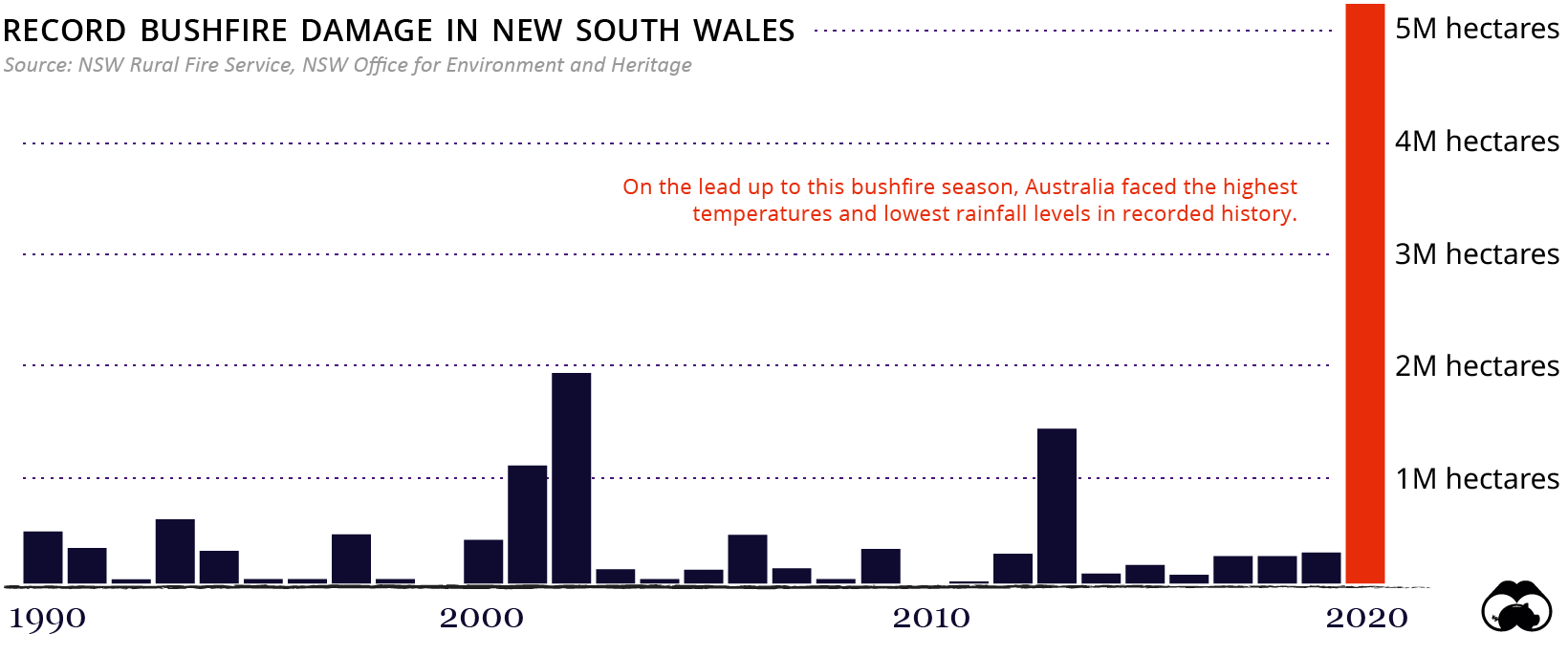
| The Top 20 Visualizations of 2020, by Visual Capitalist - Visual Capitalist Posted: 26 Dec 2020 10:32 AM PST Can you remember a year more life-changing than 2020? Over a million lives were lost in the pandemic, oil prices turned negative, and protests swept the streets. At the same time, 10 years of technology advancements seemed to happen in mere months—and now vaccinations are rolling out at a record speed. Below, we round up some of the year's biggest news events with charts and visualizations. Graphic #1 ⟩⟩ January 2020Australian BushfiresFor some in the Southern Hemisphere who ushered in the new year first, it started on fire. Reuters assessed the scale of the damage caused by bushfires across Australia. In fact, total burned areas reached 18.6 million hectares (186,000km²) by March, bigger than the total land mass of entire countries like Cuba. Here's the damage done in the state of New South Wales alone, compared to previous years:
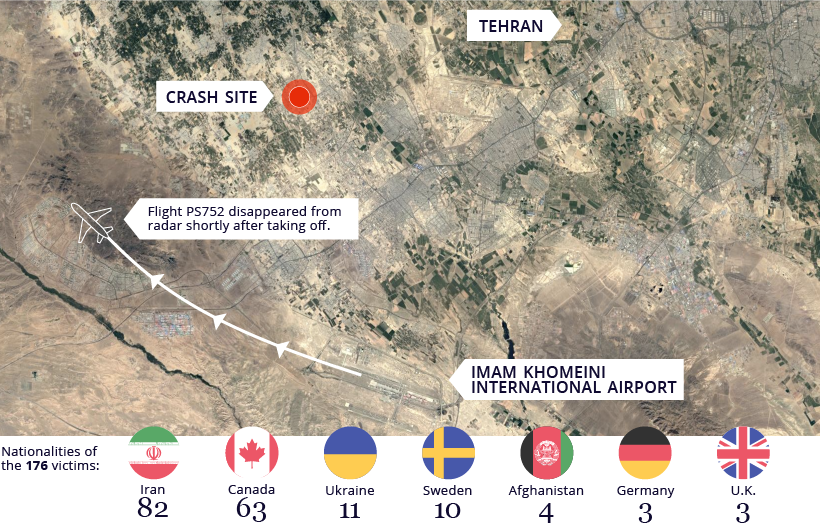
While bushfires are common in Australia, this year, dry conditions fueled the flames. The fires raged for nearly 80 days, displacing or killing nearly 3 billion animals—a devastating biodiversity loss for the country. Graphic #2 ⟩⟩ January 2020Rising Iran–U.S. TensionsIn early January, a U.S. air strike incinerated the car of General Qassim Suleimani, a security mastermind and one of Iran's most powerful military strategists. U.S. officials claimed that Iran was planning an "imminent" attack. In retaliation, Iran fired two rockets at U.S. military bases located in Iraq. No one was killed. As tensions escalated, the U.S. House of Representatives passed a bill to try and restrict President Trump's use of military power against Iran without approval.
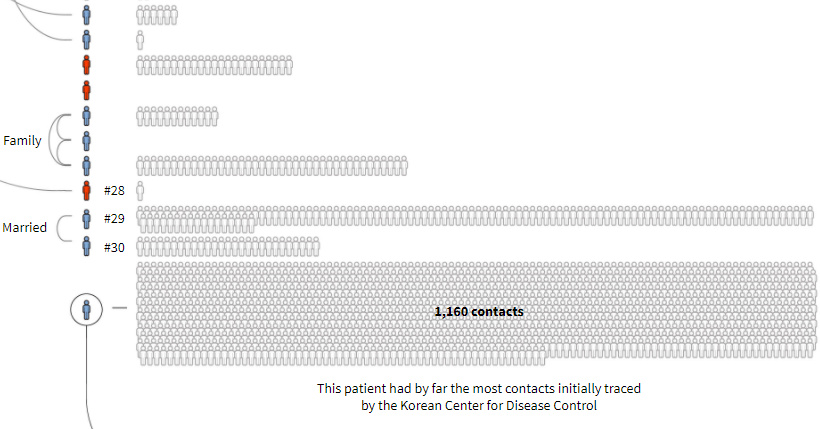
Later, in mid-January, Iran's Revolutionary Guard admitted that it mistakenly shot down a Ukrainian passenger jet, responsible for the death of 176 people. Graphic #3 ⟩⟩ March 2020The Spread of the "Novel Coronavirus"You've heard of Patient Zero, but what about Patient 31? Before February, cases of the still unnamed virus were largely contained within China, with the rest of the world cautiously observing the country's containment efforts. Slowly, but surely, the virus began to spread beyond China's borders. South Korea's 31st confirmed COVID-19 case—which was behind the rapid spread of the virus to potentially up to 1,160 contacts in the country—served as a warning to the rest of the world of how fast the virus could spread.
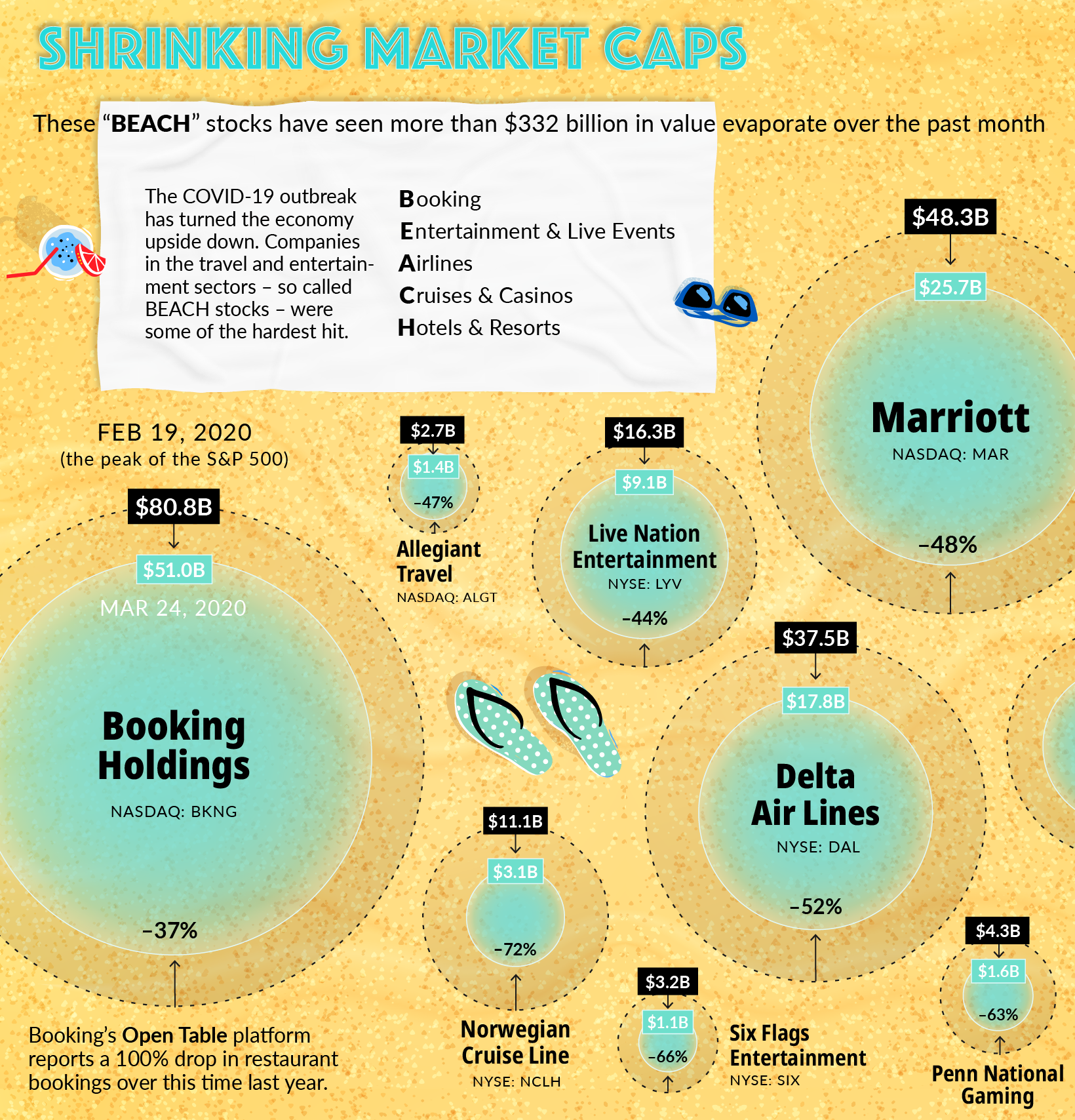
Reuters' unique graphic explainer uncovers how just one typical day of multiple "normal" interactions had significant super-spreader effects. Graphic #4 ⟩⟩ March 2020The Coronavirus CrashThe S&P 500 erased over a third of its value in under a month—the fastest 30% decline ever recorded on the benchmark index. As a result, the global tourism industry suffered dramatic losses, with countless cruise ships docked and passenger flights traveling at half-capacity.
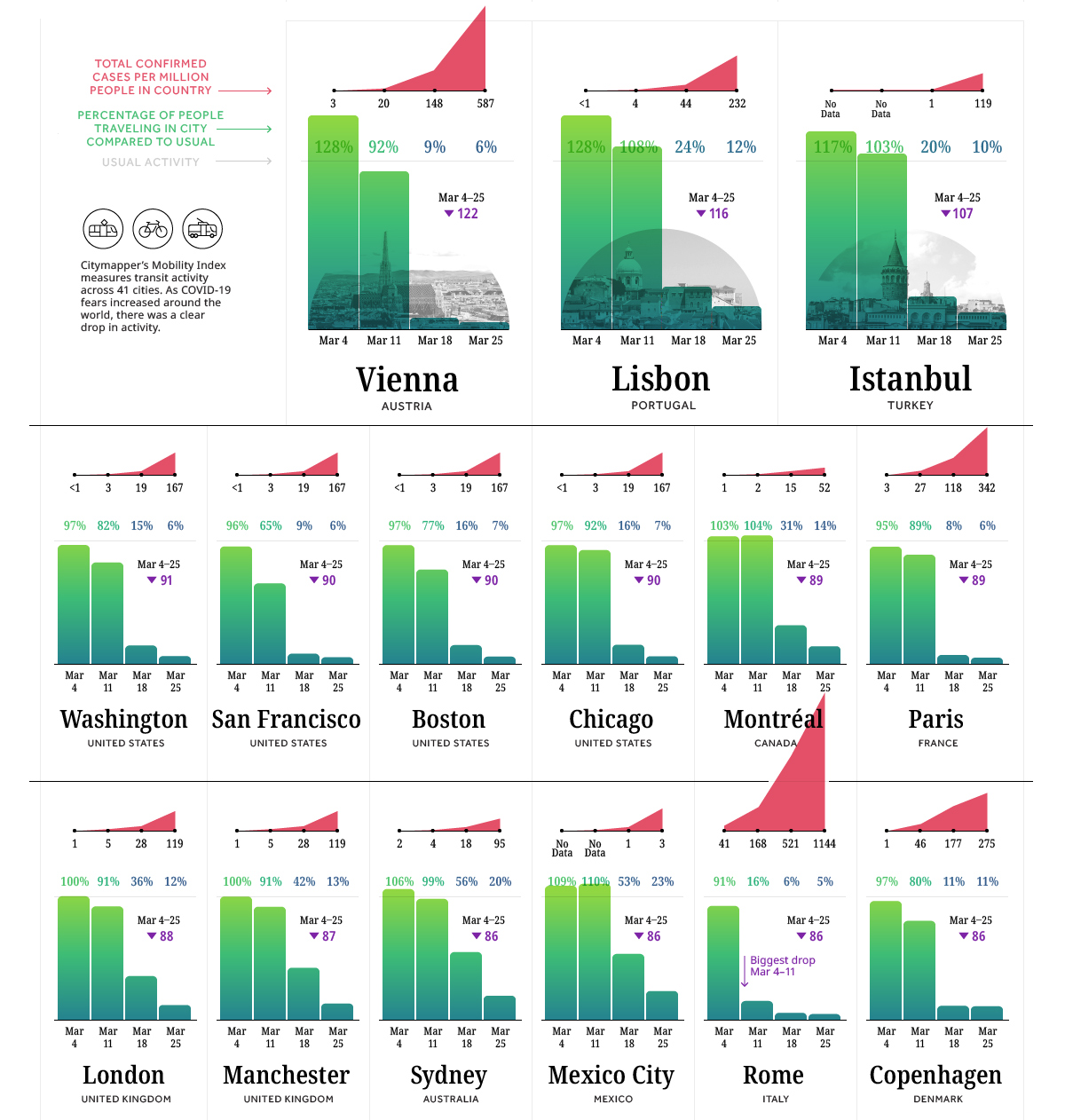
This graphic shows the BEACH stocks—booking, entertainment & live events, airlines, cruises & casinos, hotels & resorts—that were most impacted by worldwide travel bans. While some of these stocks have since recovered, the ongoing impact of COVID-19 is still most widely being felt among companies in these types of industries. Graphic #5 & 6 ⟩⟩ March 2020Lockdown Life BeginsFrom toilet paper hoarding to limits on gatherings, the pandemic's immediate effects on our surrounding environment became clear as early as March. As daily life came to a standstill, commuter activity in major cities plummeted throughout the month.
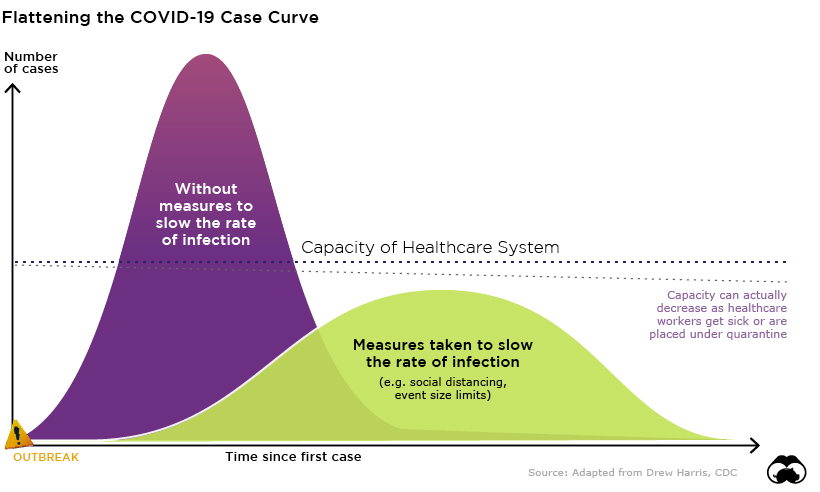
One unintended positive consequence of these shutdowns? Air pollution, such as nitrogen dioxide (NO₂) emissions also steeply dropped alongside these restrictions on movement. Possibly the most well-known diagram of the pandemic is the one that introduced the world to the phrase "flatten the curve", showing why it was important to prevent and delay the spread of the virus so that large portions of the population aren't sick at the same time.
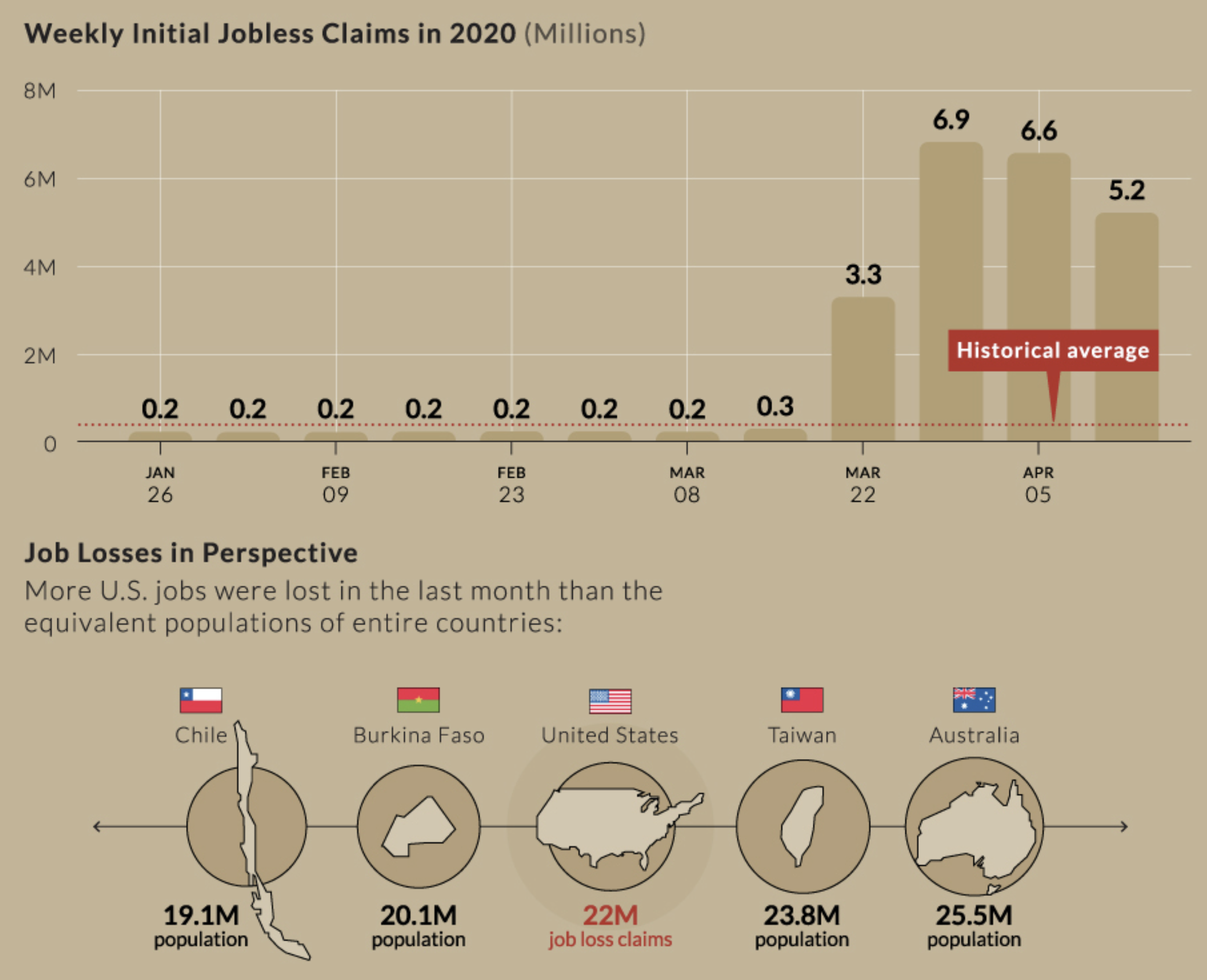
Graphic #7 ⟩⟩ April 2020Historic U.S. Job LossesAfter the World Health Organization declared COVID-19 a global pandemic on March 11, unemployment figures soon hit historic proportions. Within a month, 22 million in the U.S. had filed jobless claims.
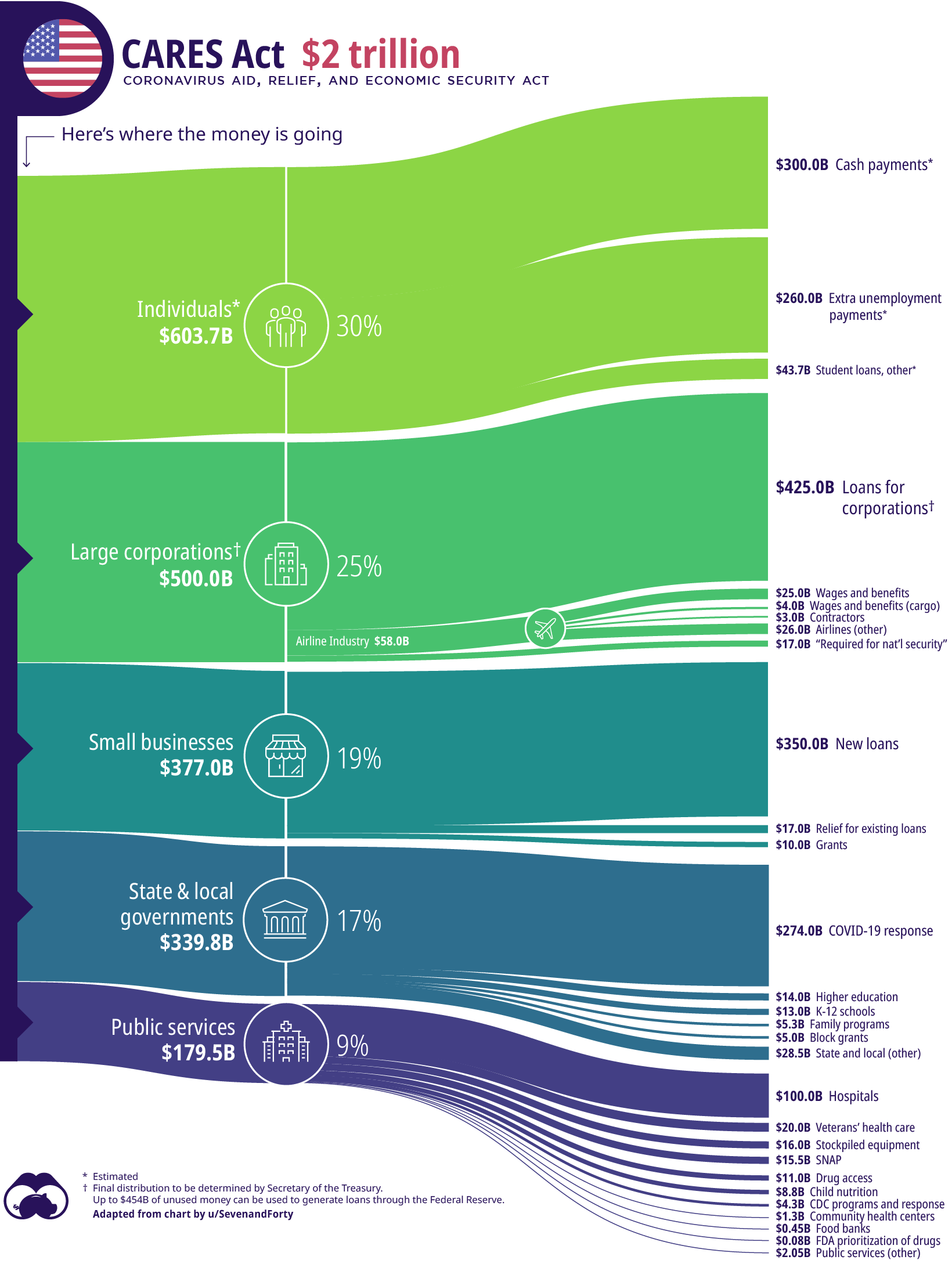
To put this in perspective, U.S. unemployment levels in 2020 were roughly 10 times higher than previous peak unemployment levels in absolute terms. Or, to look at it another way, this is equivalent to the entire population of Chile or Taiwan. Graphic #8 ⟩⟩ April 2020Stimulus Announced in the U.S.On March 27, the $2 trillion CARES Act came into law after facing minimal resistance from the House and Senate. We broke down the historic relief package in the Sankey diagram below.
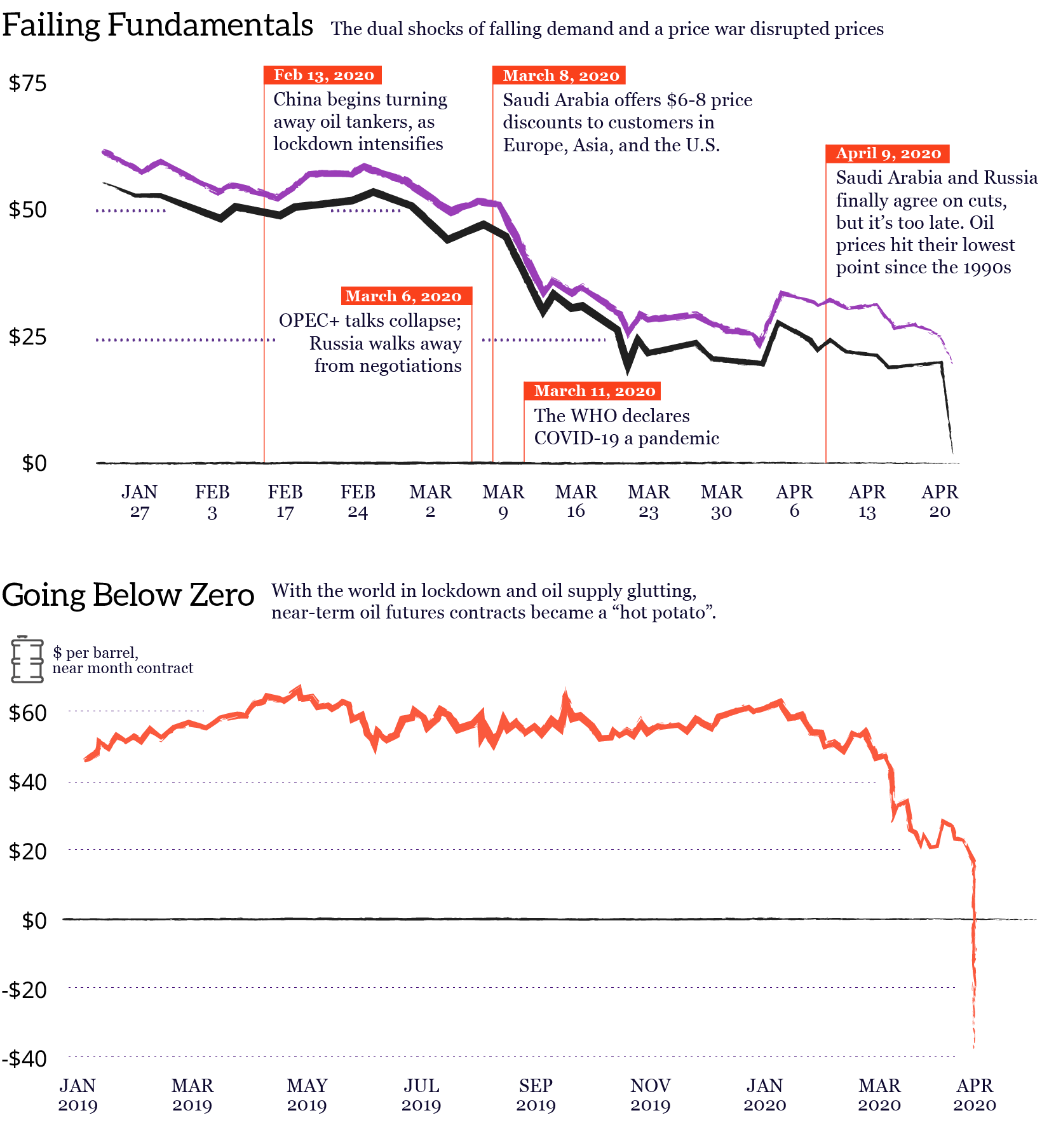
The relief package included $1,200 direct deposits to individuals, over $350 billion in relief for small businesses, and an excess of $100 billion for the U.S. health system. Graphic #9 ⟩⟩ April 2020Oil Prices Go NegativeIn another historic event, oil prices went negative for the first time in history. Futures contracts for WTI oil fell to a stunning -$37.63 on April 20th, with producers actually paying traders to take oil off their hands.
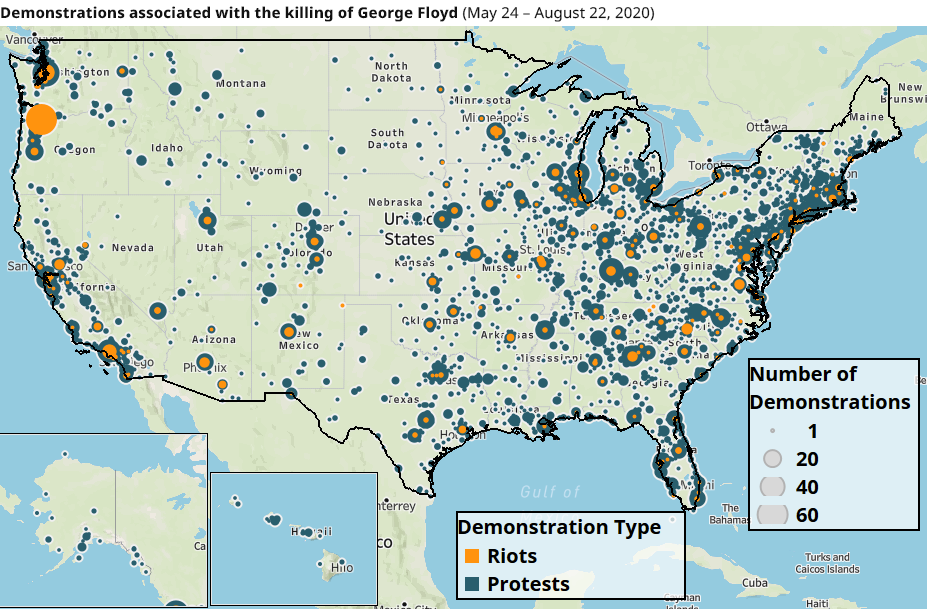
Oil has since recovered from this shock, cruising back to more typical price levels. Graphic #10 ⟩⟩ May 2020Black Lives Matter Protests"I can't breathe." These few words sparked the ongoing flames of a significant movement this summer: Black Lives Matter (BLM). After the killing of George Floyd on May 25, by police, the Armed Conflict Location & Event Data Project (ACLED) recorded over 7,750 BLM-linked demonstrations over a three month span.
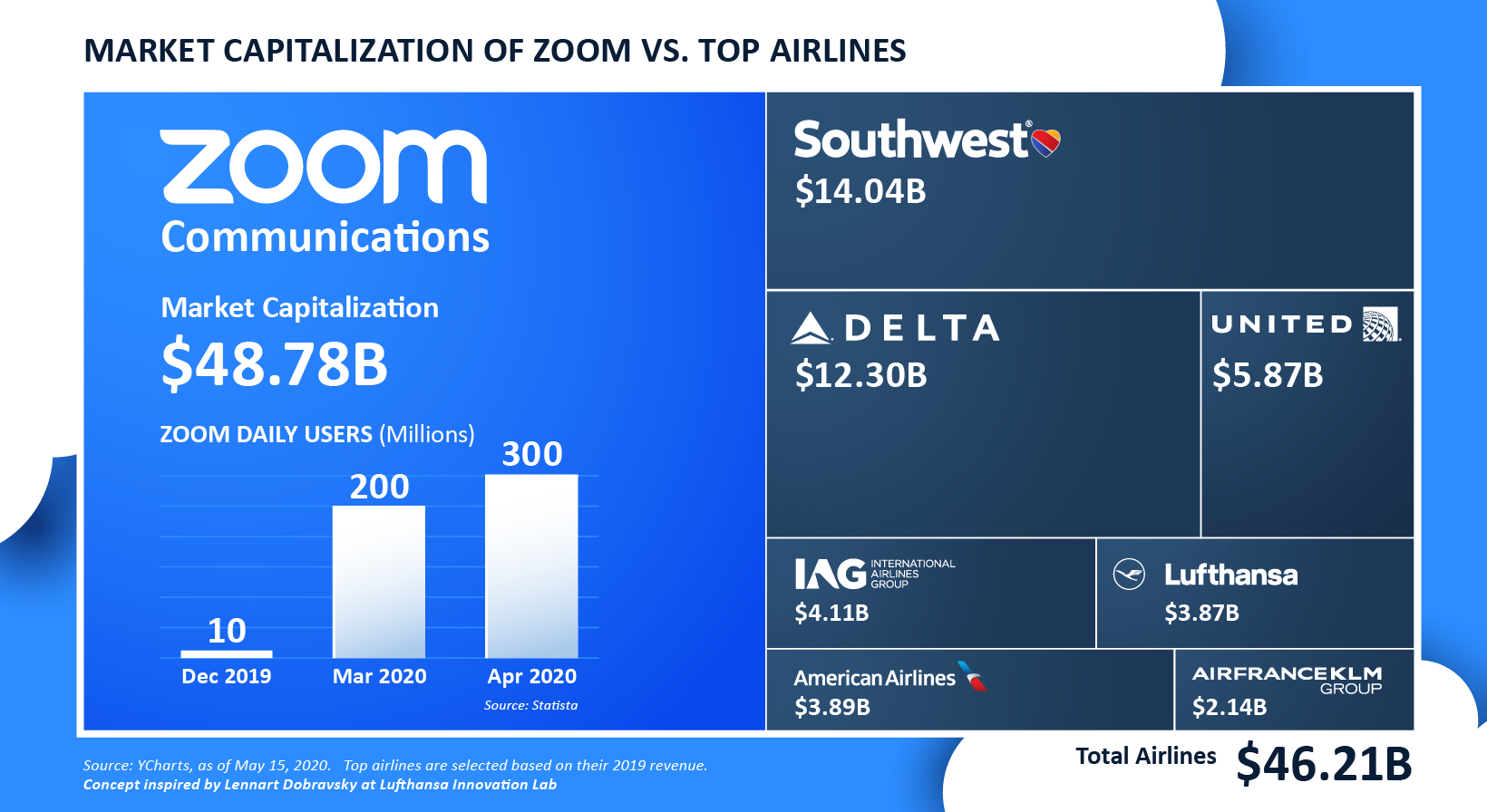
The nationwide pattern of civil unrest is well-documented, but there's been no time like the present to demand change. Though images of burning cars and police clashes dominated the headlines, in the end, 93% of the protests were peaceful. There's also been a ripple effect, with thousands of similar rallies reported in countries around the world. Graphic #11 & 12 ⟩⟩ May 2020The World Works from HomeThe dramatic shift to staying at home has resulted in a much higher reliance on technology for many people. Nowhere were these trends exemplified more than the rise of video conferencing software Zoom—the platform was used for work, education, and socializing alike. As monthly users swelled, those who typically take to the skies also declined in a steep fashion. In this graphic from May, we noted that Zoom's market capitalization had skyrocketed to eclipse the top seven airlines by revenue, combined.
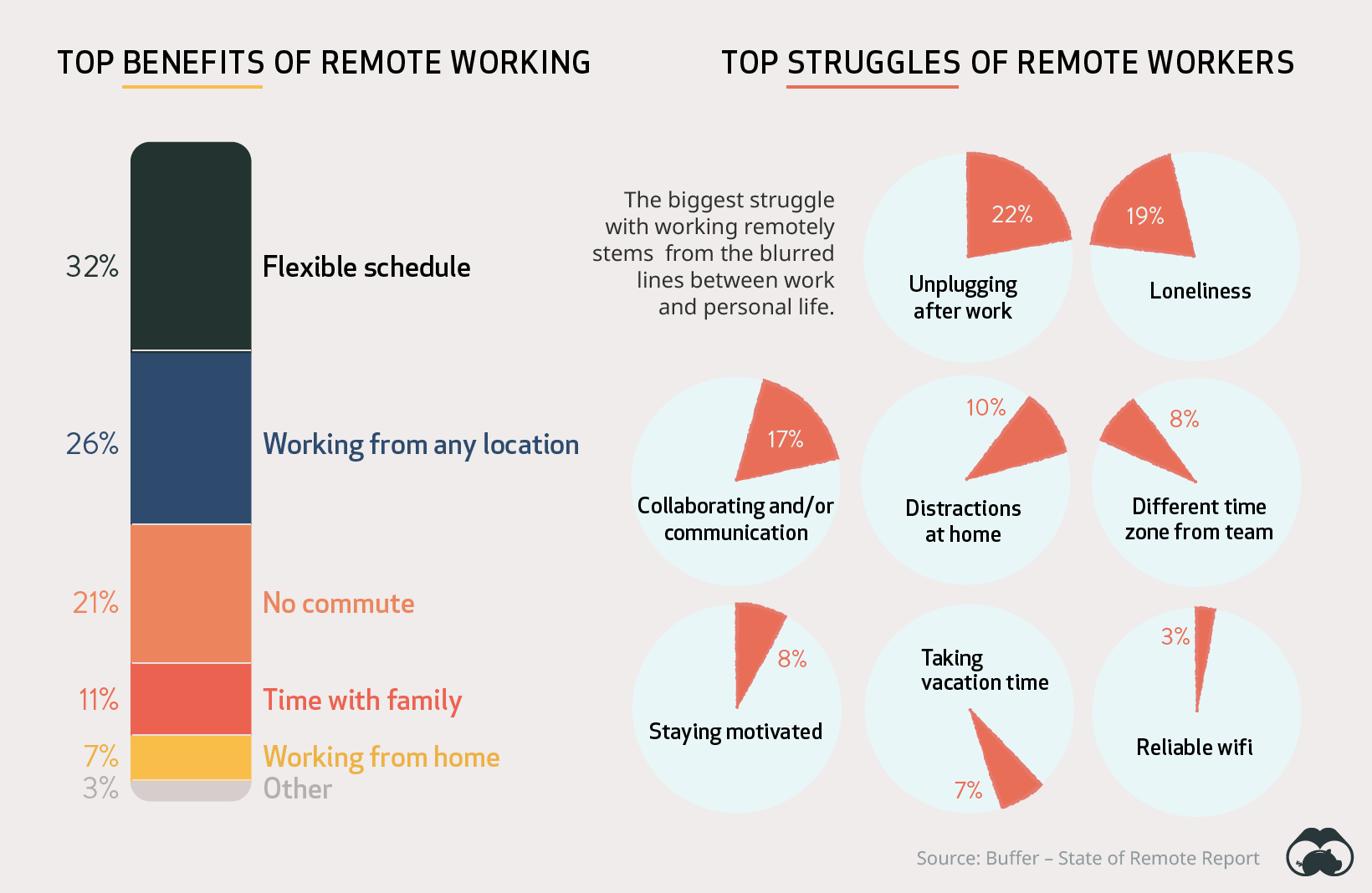
As remote work became the new normal for significant shares of the workforce, unique benefits of this adjusted lifestyle arose, but it didn't come without its challenges.
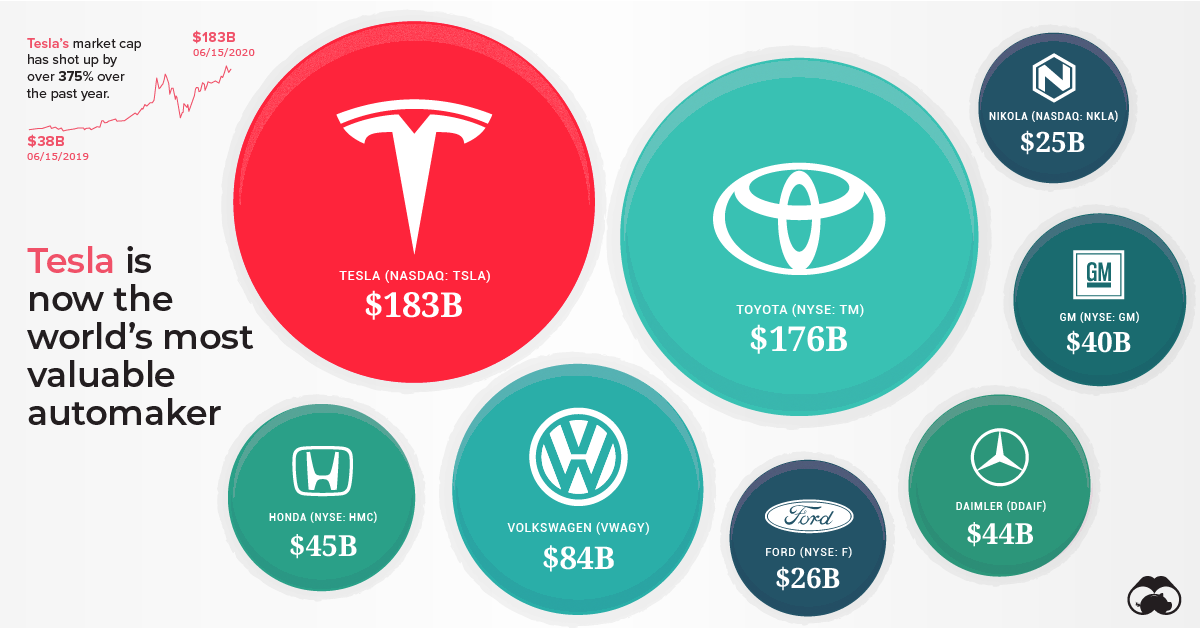
Perhaps the most significant lasting change from the COVID-19 pandemic might be the adoption of flexible work, even by firms that resisted the trend in the past. If many employees continue to work remotely, even part of the time, then that will have a big impact on everything from the commercial office market to the bottom line of SaaS companies that help facilitate remote collaboration among teams. Graphic #13 ⟩⟩ July 2020Tesla becomes World's Most Valuable Automaker2020 was a hallmark year for Tesla. In June, it became the most valuable automaker in the world—surpassing the likes of Toyota, Volkswagen, and Honda. Tesla's market valuation climbed over 375% since June 2019. While these soaring figures are one factor behind its rise, others include record Model 3 sales, which prompted market euphoria.
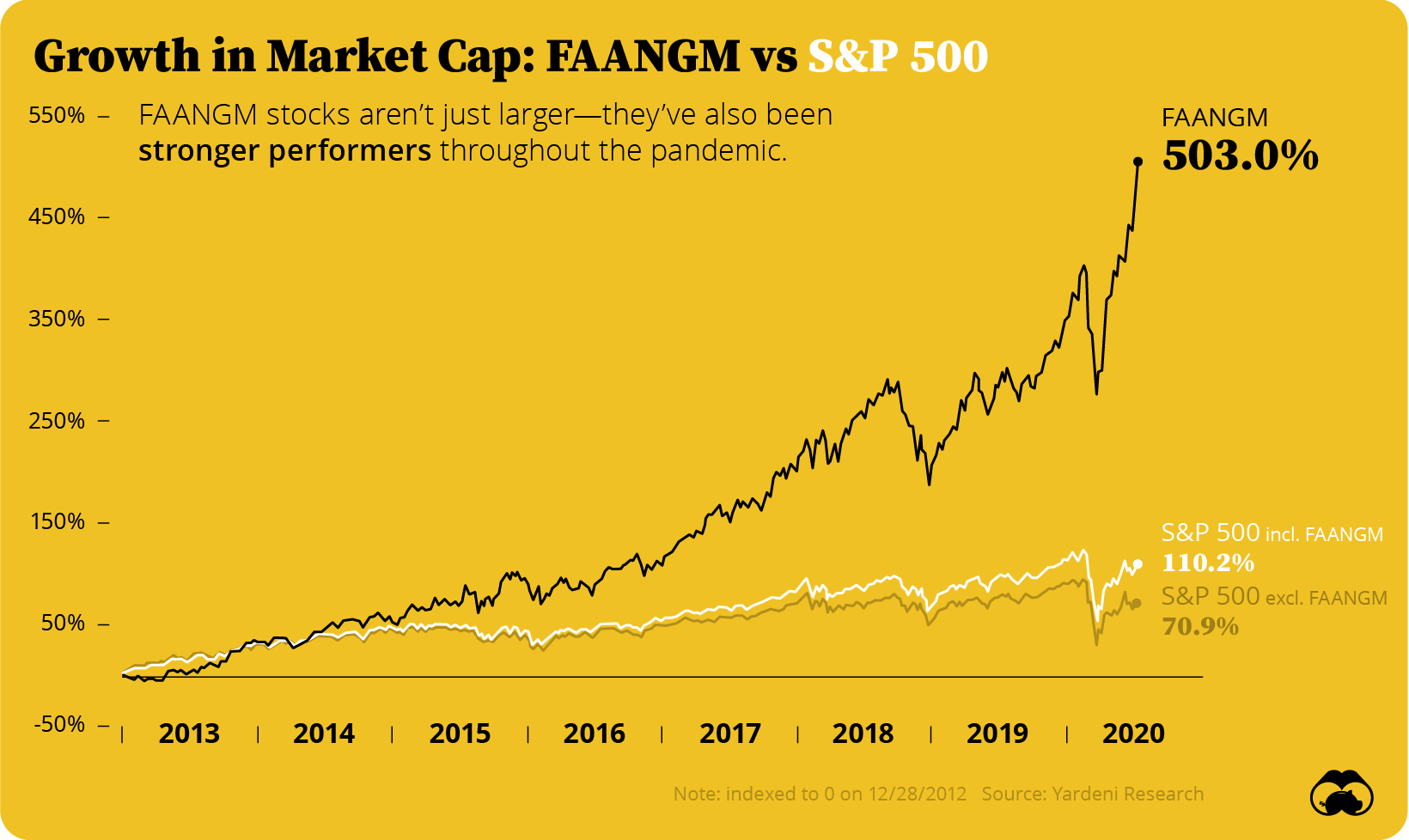
But Tesla's story is far from over. The company is now worth more than the largest nine automakers combined, and is set to enter the S&P 500 officially on December 21, 2020. Tesla will be the most valuable company to ever enter the index, ranking as the eighth-largest overall. Graphic #14 ⟩⟩ July 2020Big Tech's DominanceIn many ways, COVID-19 only accentuated differences in market share, earnings, and wealth. For one, Big Tech's market cap share of the S&P 500 soared. In the seven years preceding July, the market cap of the six stocks—Facebook, Apple, Amazon, Netflix, Alphabet, and Microsoft—grew over 500%. By contrast, the S&P 500 rose just 110%.
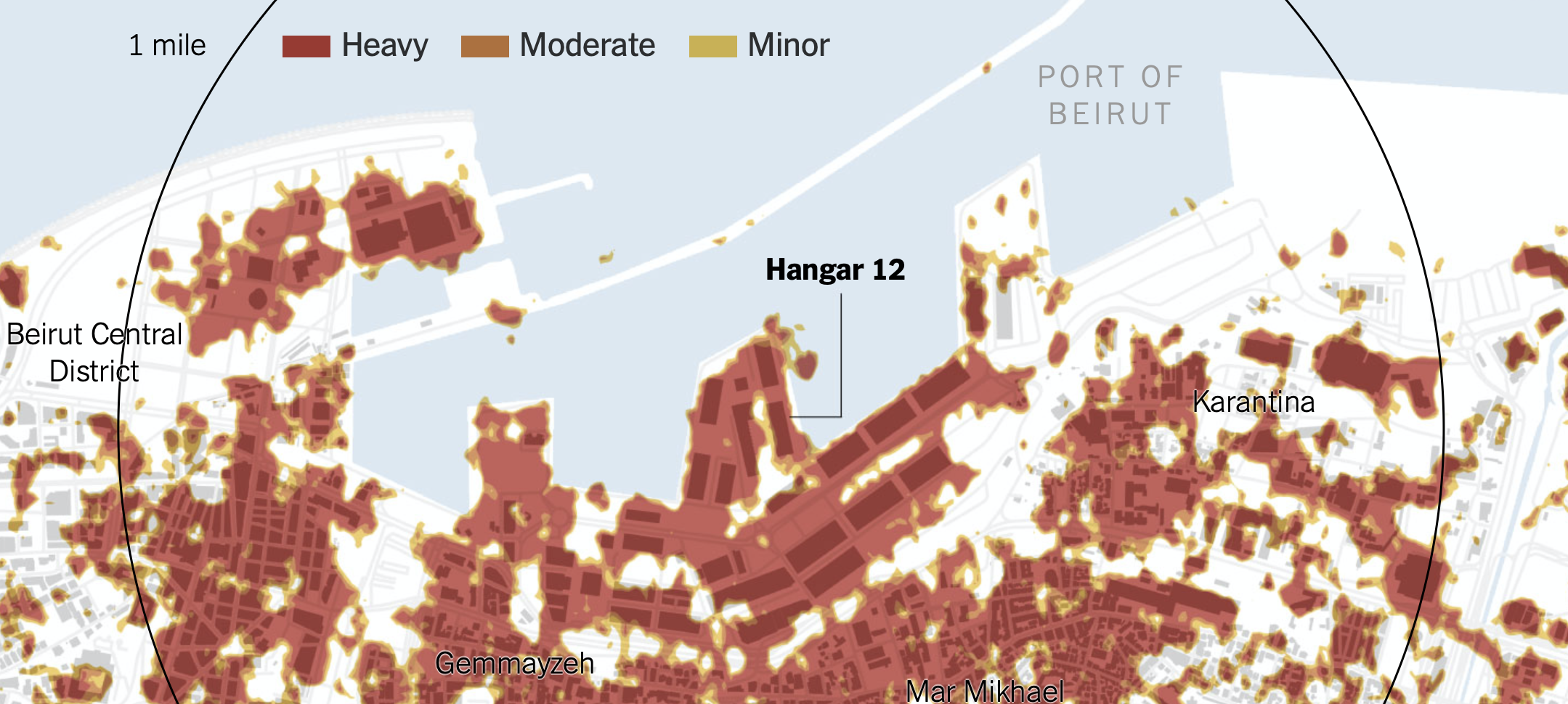
At the same time, Big Tech's concentration reached record levels, with the five largest companies accounting for over 20% of the index's total value. Graphic #15 ⟩⟩ August 2020Beirut ExplosionWhile the world grappled with numerous biological and natural disasters, human-error led to a deadly explosion that rocked Beirut's port. The blast was broadcast around the world in real time as people filmed the fire on their devices. Using satellite data, NASA and NYT mapped the extent of the damage, which claimed 135 lives and affected 305,000 more.
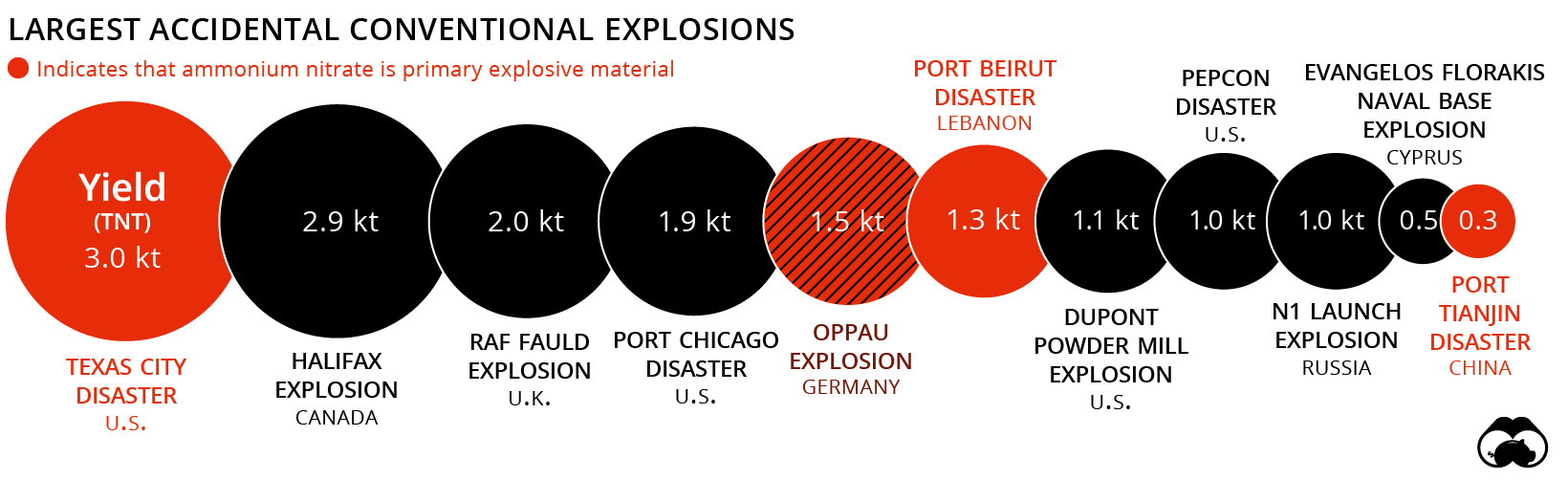
This explosion was the biggest accident of its kind in modern history, triggered by the exposure of combustible ammonium nitrate—a key ingredient in fertilizers—to an open flame due to poor storage. Beyond the human toll, the financial cost of this explosion is estimated at above $15 billion.
Graphic #16 ⟩⟩ August 2020Shortest Bear Market in History EndsIn a stunning reversal, the bear market of 2020 ended on August 18 when the S&P 500 exceeded previous February highs. As trillions of dollars in stimulus response got injected into global economies, markets recovered in record time.
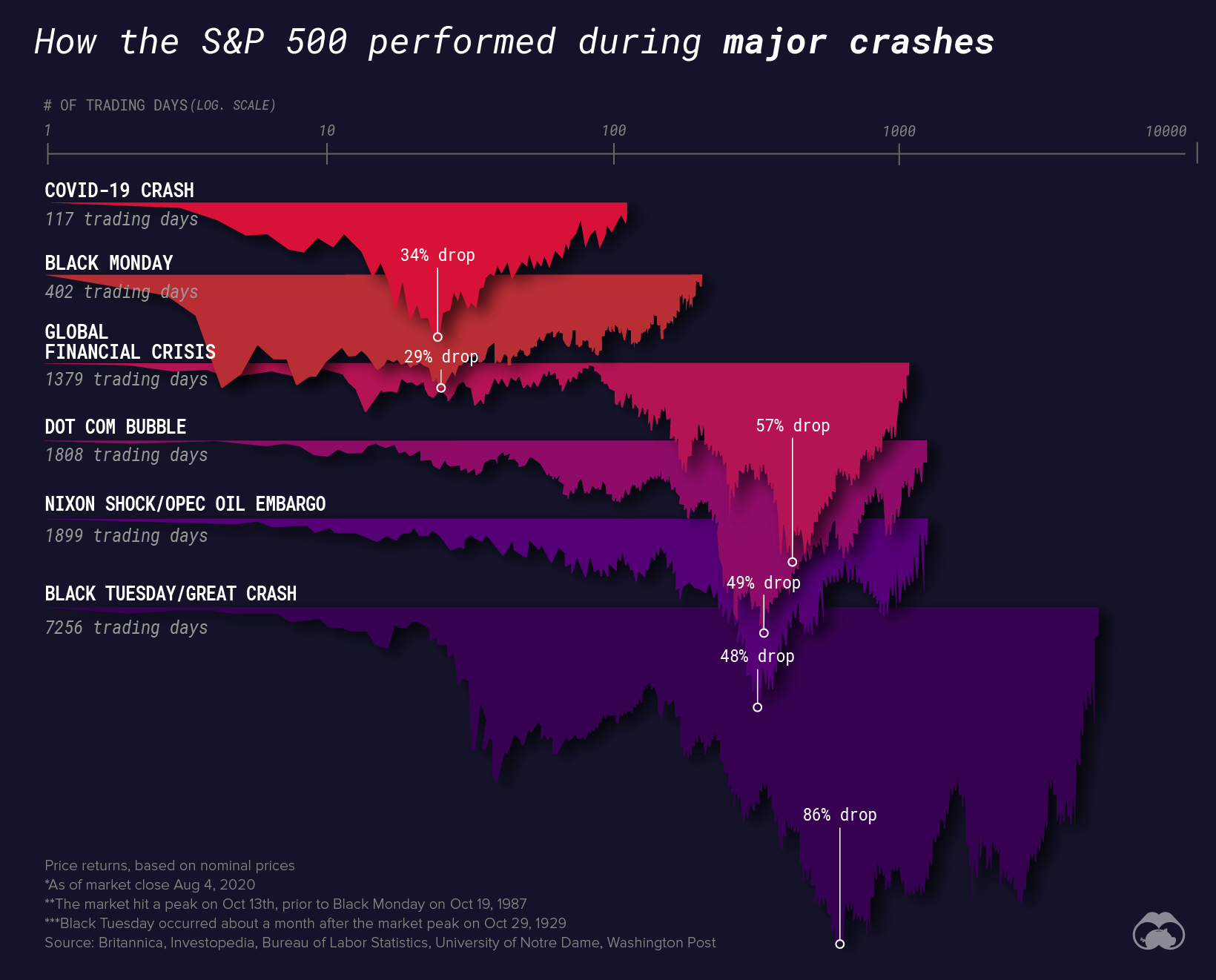
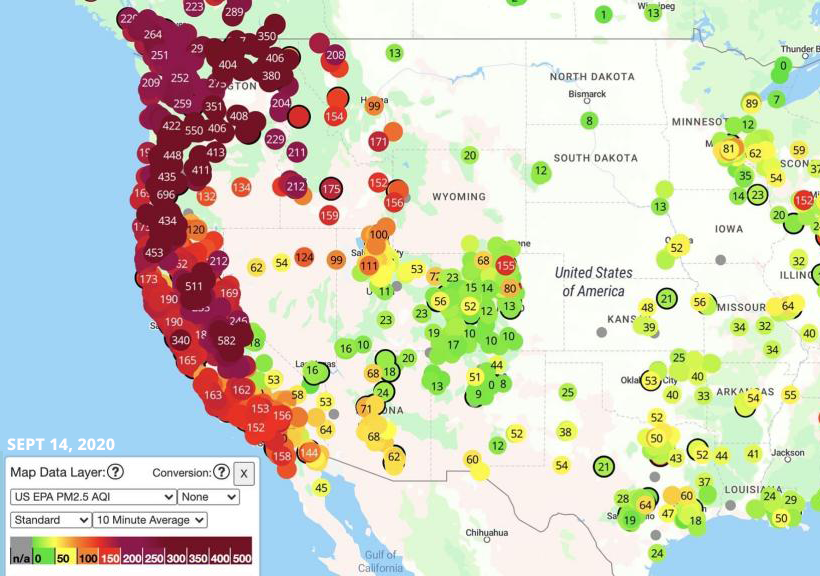
Just two weeks before the shortest bear market in history ended, we published a graphic comparing previous stock crashes—from 1987's Black Monday to the Nixon Shock of 1973—exposing the duration and intensity of market downturns since 1929. Graphic #17 ⟩⟩ August 2020U.S. Wildfire SeasonReddish-orange skies might seem otherworldly, but this fall, they were a common sight across the West Coast of North America, where air quality reached the "hazardous" category for long stretches of time.
2020 was the most active year on record for wildfires yet, with California and Oregon being particularly hard-hit. While some wildfires are caused by natural occurrences like lightning strikes, an overwhelming majority (85-90%) happen because of human causes such as discarded cigarettes and campfire debris.
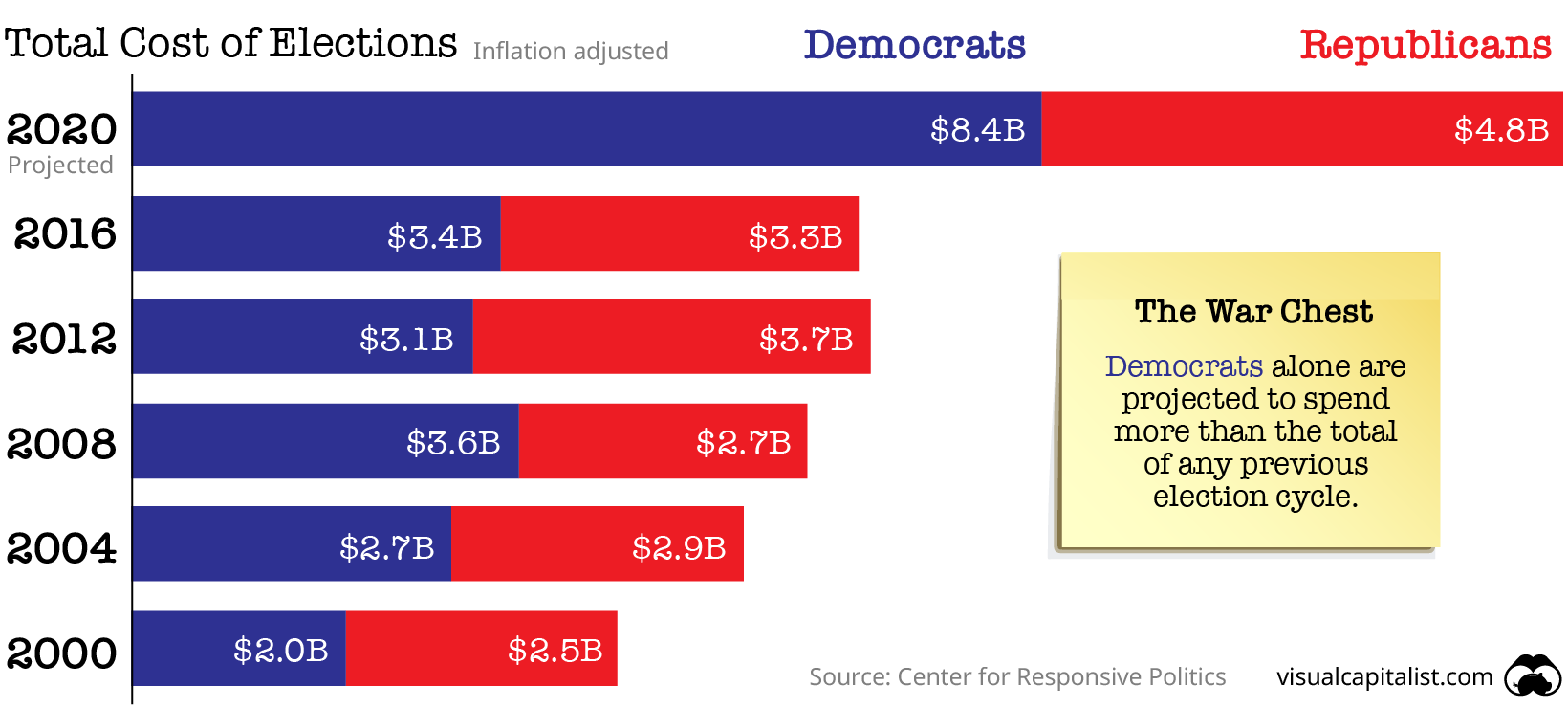
– Noah Diffenbaugh, professor and senior fellow at Stanford University Graphic #18 ⟩⟩ November 2020The 2020 U.S. Presidential ElectionIn 2020, U.S. election spending hit over $13 billion, more than twice the amount spent on the entire 2016 election. Of this total, congressional spending topped $7 billion, with Democrats spending 64% more than Republican candidates for the House and Senate.
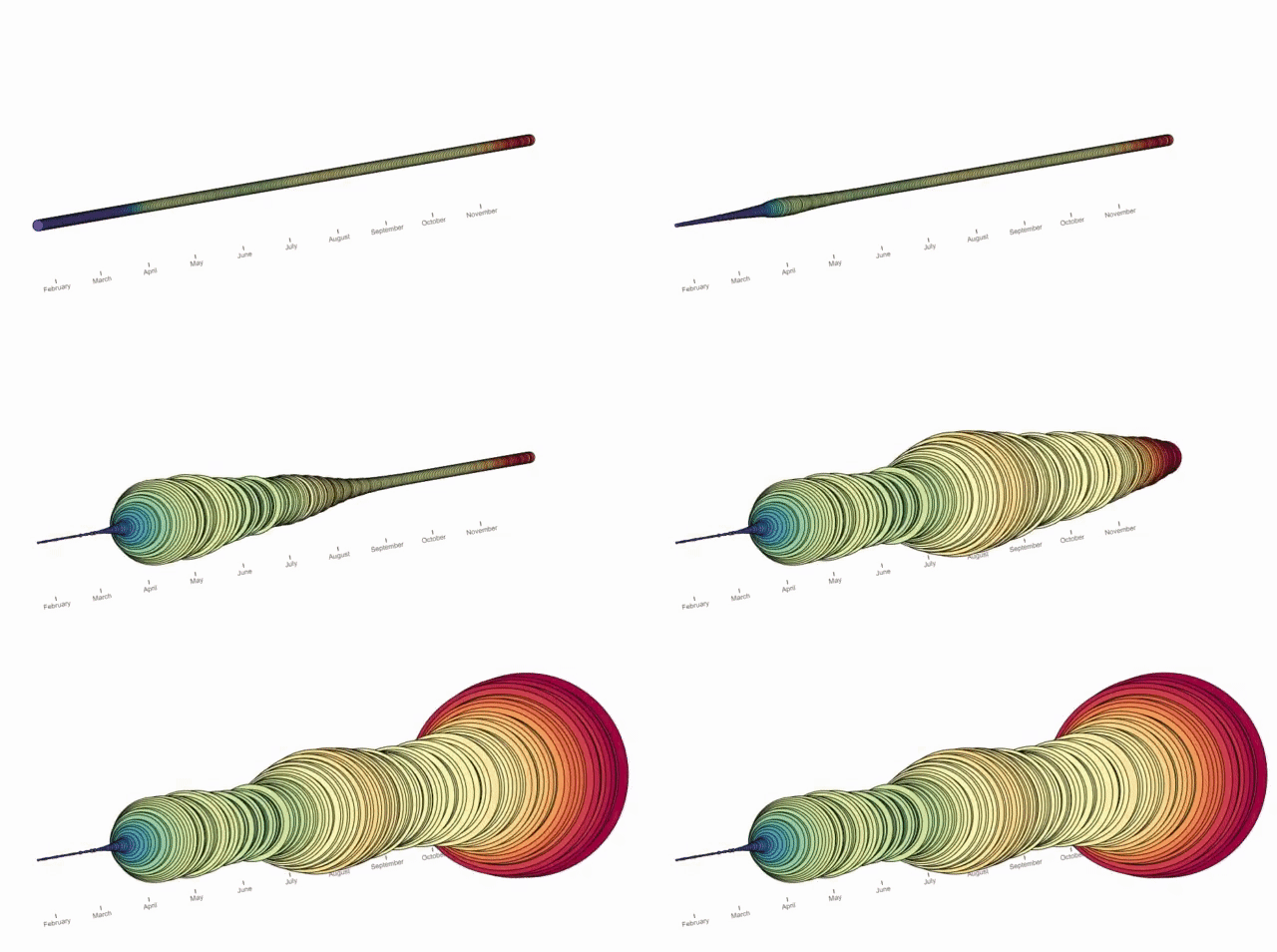
President Biden was the first candidate ever to raise $1 billion, while Trump raised $596 million. Graphic #19 ⟩⟩ December 2020COVID-19's Third WaveLike history tells us, pandemics come in waves. The third wave of COVID-19 escalated in November, when cases began to surge. On November 8, the seven-day average of new daily cases hit 100,000 in America. By the end of November, global cases soared to 60 million. Since then, cases have trended upward, leading local governments worldwide to enforce social distancing requirements for the winter holiday season. The below graphic from Reddit helps show the latest surge in cases in the U.S.:
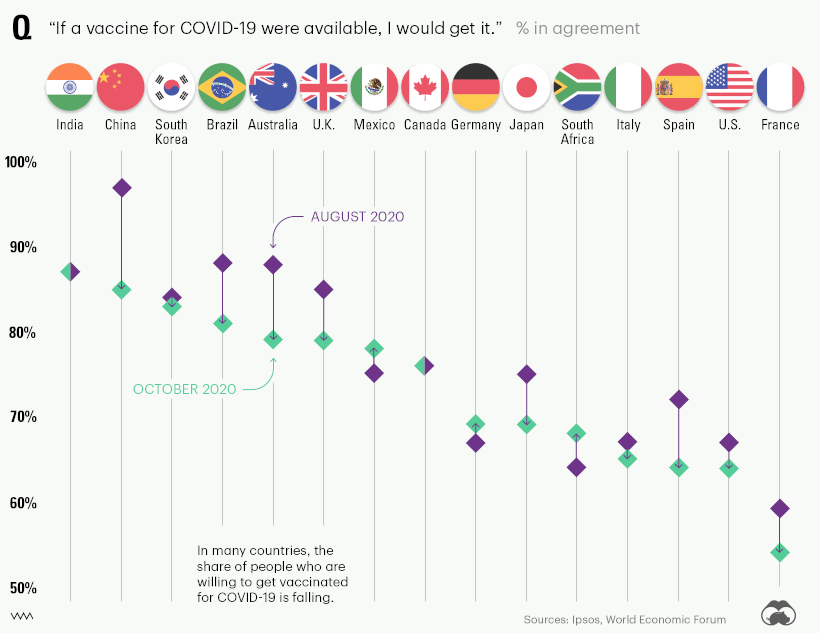
Graphic #20 ⟩⟩ December 2020Global Vaccination Effort Kicks OffIn more recent news, Pfizer made waves when it announced it was rolling out a 95% effective COVID-19 vaccine. Then followed Moderna, at 94.5% in mid-November. As the global vaccination race intensifies, Bloomberg tracks the progress of nine vaccines and 80 publicly disclosed distribution deals representing 7.95 billion vaccination doses. However, even with viable vaccines, challenges still exist. All around the world, perceptions of vaccine safety have dropped significantly, which may complicate an economic recovery.
On to the Next OneAfter the wild ride that was 2020, many people are wondering what 2021 will have in store. In the first half of the year, vaccine distribution will surely take center stage. As well, economic recovery will be in focus as physical businesses resume more typical activity and regions slowly open up travel and tourism again. Much like the financial crisis of 2008 was an inflection point for the economy, the COVID-19 pandemic has changed the course of human history. Chaos can breed opportunity, and even though unemployment spiked to record highs in the U.S., new business applications did as well. Will things return to "normal"? As the many twists and turns of the past year have demonstrated, our complex, interconnected world is far from static. The next black swan is always just around the corner.
|
| We didn’t all have a choice - The Age Posted: 27 Dec 2020 03:00 AM PST My biannual UK ''holidays'' in 2018-19 were to provide palliative care to my mother then move my 96-year-old father into residential care and settle their affairs. If the pandemic had hit in mid-2018, I could not possibly have flown home on a whim. Our father received no visits in 2020 from his Melbourne daughters, his only immediate family, taking a huge toll on us all. At this stage, it appears unlikely we can visit him again until late 2021, if then. Many Australians got trapped interstate and overseas in similar circumstances. Shortening a holiday is an easy decision. Abandoning a career or your vulnerable loved ones is a much tougher choice. They should welcome it Shouldn't they be thankful they have assurance none of their crew will be COVID-positive, and avoid expensive lawsuits if they were responsible for exposing passengers to COVID-19, such as what United airlines may now face? Keep up the good work, Victoria. We need to continue to be tough with anyone coming in. The population problem Associated with both climate change and deforestation was the unmentioned elephant in the room. The word no one seems to be able to say now at Christmas or, it seems, at any time soon. The word that screamed out at me all through Waleed's article is overpopulation of the planet. I guess David Attenborough talks about it but I can't think of a government of any country that is talking about it or taking any action to deal with overpopulation, let alone our own government. All I can say with deep sincerity is may God help us all, as we seem unable to help ourselves. We are the enemy That we are not immune is desperately clear. No vaccine will protect us from hardness of heart, greed or lack of political will. No lockdown will preserve our vulnerable biodiversity or forest-life from depletion while humans continue to contaminate and eradicate. We are the enemy who have lost our way. "Live and let live" in the right relationship is our duty of care and our pathway to future survival. A troubling sight It seems we now have a Liberal government so determined to maintain its spin as ''not being Victoria'' or another one of those so-called restrictive and reactive Labor state governments that the NSW political authorities are taking unacceptable and dangerous risks. Even more troubling, it seems that the NSW public health authorities are being dragged into the political framing. The picture of the NSW political leaders being dragged day by day, or is it hour by hour, to the level and form of safeguards actually required provides a stark contrast with the clarity, consistency and resolution exhibited by Daniel Andrews and his team. If Australia is to get through this long summer with the minimum incidence and impact of coronavirus, it would be constructive for the political leaders and elements in the media to set aside this potentially deadly political point-scoring and turn that well-worn cliche of being in this together back into a practical basis of policy, media framing and on-the-ground reality. Hard to take seriously The only conclusion I fail to see why such a decision has now been made. There is only one conclusion: that the government wishes to hide the finding because of the way Christine Holgate was pilloried by the Prime Minister in Parliament, where she had no defence. I find this so disappointing and unjust but it seems to be becoming the modus operandi of the Coalition government. Co-opting the pandemic In other words, Switzer's purpose is ideological rather than sentimental. He enlists a pandemic to peddle an ideological cure-all – our wellbeing depends on free market competition, and anything that impedes that also harms us. As the problems caused by neoliberal ideology mount around the world, Switzer increasingly reminds me of Monty Python's Black Knight (''it's just a flesh wound''), fighting on despite the odds, and the obvious. Christmas Island beckons We need specially designed quarantine centres, (not hotels), facilities well away from major population concentrations. But wait, don't we already have such a remote place, on an island off the West Australian coast? Of course, the present family of two adults and two young children would need relocating from their residence on Christmas Island. I believe a home and a warm welcome would be waiting for them in Biloela, Queensland Devaluing the day AND ANOTHER THINGThe pandemic  Credit: The cricket Politics What's the chance of Christine Holgate getting her old job back? Seems that she acted too hastily in resigning after Scott Morrison goaded her in Parliament before the investigation into the Cartier watches had even commenced. How many federal, state and territory parliamentary and electorate staff got Christmas presents paid for by taxpayers? The Morrison government (and the opposition) should adopt Radio National's slogan and "think bigger". On the coronavirus, China and, especially, climate change. Signed, sealed, delivered Furthermore What exactly is ''revert back'' except being really irritating? Finally Note from the EditorThe Age's editor, Gay Alcorn, writes an exclusive newsletter for subscribers on the week's most important stories and issues. Sign up here to receive it every Friday. Most Viewed in NationalLoading |
| Cleveland APL pets of the weekend: Bliss and Buffy - Yahoo News Posted: 26 Dec 2020 07:36 AM PST  The Conversation China can still salvage 'one country, two systems' in Hong Kong – here's howAuthorities in Hong Kong may have hoped to start 2020 by putting a turbulent period of sustained, often violent protests behind them. Instead hundreds of thousands of protesters ushered in the new year by taking to the streets. Around 400 were arrested as protesters continued their push for political reform on the densely populated island.The clash between the government and demonstrators is now seven months long and has served to further erode Hong Kongers' trust in China's commitment to the "one country, two systems" formula. Under that principle, the region was granted a degree of autonomy over its own matters in 1997. But a perception that Beijing is increasingly imposing its authority has led not only to a more militant protest movement, but one that is eyeing separation from the mainland.As a political scientist who has closely followed political developments in Hong Kong over the last decade, I have watched trust in Beijing ebb away during the sustained unrest.If China wants to correct this course and convince Hong Kongers that their best hope lies in autonomy rather than independence, then I believe it must permit genuine democracy in the region. Cycle of unrestThe people of Hong Kong have not had much of a say in their own destiny. Not only did they lack political power as a colony of the British, but they also weren't consulted in the drafting of the 1984 Sino-British Joint Declaration that set the terms for the 1997 handover of the territory from the United Kingdom to the People's Republic of China. Nevertheless, that agreement offered an implicit bargain to Hong Kongers: They would submit to Beijing's sovereignty in return for the promise of a "high degree of autonomy" on the basis of "one country, two systems."Over the past two decades, major outbreaks of unrest in Hong Kong have followed attempts by Beijing to impose unwanted measures that violate this bargain. Large-scale protests beat back Beijing-directed legislative proposals dealing with sedition in 2003, national education in 2012 and extradition last year. The Umbrella Movement protests of 2014 succeeded in stymieing Beijing's proposed revisions to Hong Kong's system for selecting its chief executive, but protesters' demands for universal suffrage and an open nomination process were rejected.Many Hong Kongers consider this interference a violation of the promised autonomy built into the terms of the Joint Declaration and the Basic Law, Hong Kong's mini-constitution. This interference reinforces fears that the city will lose its autonomy entirely after 2047, the end point of commitments made under the Joint Declaration.With only limited and inadequate democratic mechanisms at their disposal, Hong Kongers have developed a vibrant and increasingly militant protest culture as a primary means for exercising political influence. Autonomy or independence?Efforts to steer Hong Kong toward greater integration with the mainland have backfired, undermining trust in Beijing's promise of a "high degree of autonomy." The result is an ongoing cycle of radicalization. The focal point for many protesters has moved away from any one particular issue to focus on the fundamental status of Hong Kong's relationship to China. Growing numbers of people are questioning why they should keep their side of the bargain – accepting Beijing's sovereignty over Hong Kong. According to a recent Reuters poll, 17% of Hong Kongers express outright support for independence from China, while another 20% express dissatisfaction with the "one country, two systems" model. Moreover, 59% of respondents said they supported the recent protests and over one-third had themselves attended a protest.According to a separate survey, support for eventual independence among young people approaches 40%. Many young people have also come to reject any "Chinese" identity in favor of a "Hong Kong" identity.The depth of discontent among Hong Kongers was reflected in the District Council elections held on Nov. 24. These low-level posts have traditionally been dominated by pro-Beijing political parties. The recent elections, however, brought a record turnout with pro-democratic parties winning close to 90% of contested positions. Beijing's miscalculationTo blunt the growth of separatist sentiment in Hong Kong, Beijing must tackle what social scientists call a "commitment problem." In any negotiation, each side will cooperate only if they believe that the other side is both willing and able to carry out any commitments made as part of the bargain. If either side believes the other side's commitments lack credibility, then cooperation fails. What China needs to do now is show that it is committed to respecting the autonomy promises embodied in the Joint Declaration and the Basic Law.I believe the best way to do that is for Beijing to stop manipulating governance of the city. As long as selection of the chief executive and a majority of the Legislative Council lies in Beijing's hands, it will be difficult for the mainland to resist meddling in Hong Kong's affairs and for Hong Kongers to feel that autonomy offers them any real say over their fate.In other words, Beijing could undercut calls for independence and interrupt the cycle of mass protests by offering Hong Kongers the ability to select their leaders through free and fair elections.Beijing badly miscalculated in 2014 when it proposed electoral reforms that fell far short of the demands of Hong Kong's pan-democratic camp, a coalition of parties that advocate universal suffrage. As a consequence, older, mainstream leaders lost control of the protest movement to younger, more militant activists. By 2019, young radicals resorted to violent street actions coupled with harsh anti-Beijing rhetoric. Yet a move toward democracy could still calm the waters provided the process allowed for genuine and effective local participation.This proposal may be far-fetched. Indeed, some accounts suggest that leaders in Beijing are laying plans to move in the opposite direction by taking more direct control over Hong Kong's political and legal institutions. Moreover, Beijing worries that full democracy in Hong Kong might lead to demands for the same elsewhere in China.If a democratic solution to China's Hong Kong problem appears unattractive to Beijing, the alternatives may be worse. The current cycle of provocation, protest, radicalization and rising separatism can lead to only one eventual result: a violent crackdown that would damage China's reputation and leave it in costly occupation of a sullen and defiant population for a generation or more.[Deep knowledge, daily. Sign up for The Conversation's newsletter.]This article is republished from The Conversation, a nonprofit news site dedicated to sharing ideas from academic experts. Read more: * As Digital Earth gains momentum, China is setting the pace * Unrest in Latin America makes authoritarianism look more appealing to some * Decade of dissent: how protest is shaking the UK and why it's likely to continueDavid Skidmore does not work for, consult, own shares in or receive funding from any company or organization that would benefit from this article, and has disclosed no relevant affiliations beyond their academic appointment. |

| You are subscribed to email updates from "labor-day-travel-deals-2018,beach-holiday-deals" - Google News. To stop receiving these emails, you may unsubscribe now. | Email delivery powered by Google |
| Google, 1600 Amphitheatre Parkway, Mountain View, CA 94043, United States | |


Comments
Post a Comment